> For the complete documentation index, see [llms.txt](https://docs.authgear.com/llms.txt). Markdown versions of documentation pages are available by appending `.md` to page URLs; this page is available as [Markdown](https://docs.authgear.com/faq-for-authentication/otp-test-mode.md).
# OTP Test Mode
Suppress message delivery and fix OTP for testing purposes
Test mode allows for control over how OTPs are handled during development and testing.
Common use cases include:
* Internal testing (e.g. Allowing specific accounts to authenticate with fixed codes for ease of testing).
* Testing SMS, WhatsApp, or email login via OTP, but don't want to rely on the actual OTP delivery.
* App Store Reviewers. See [Tips for Apple App Store Review with Passwordless Login](/faq-for-authentication/passwordless-demo-user-for-apple-app-review.md).
## How to enable test mode
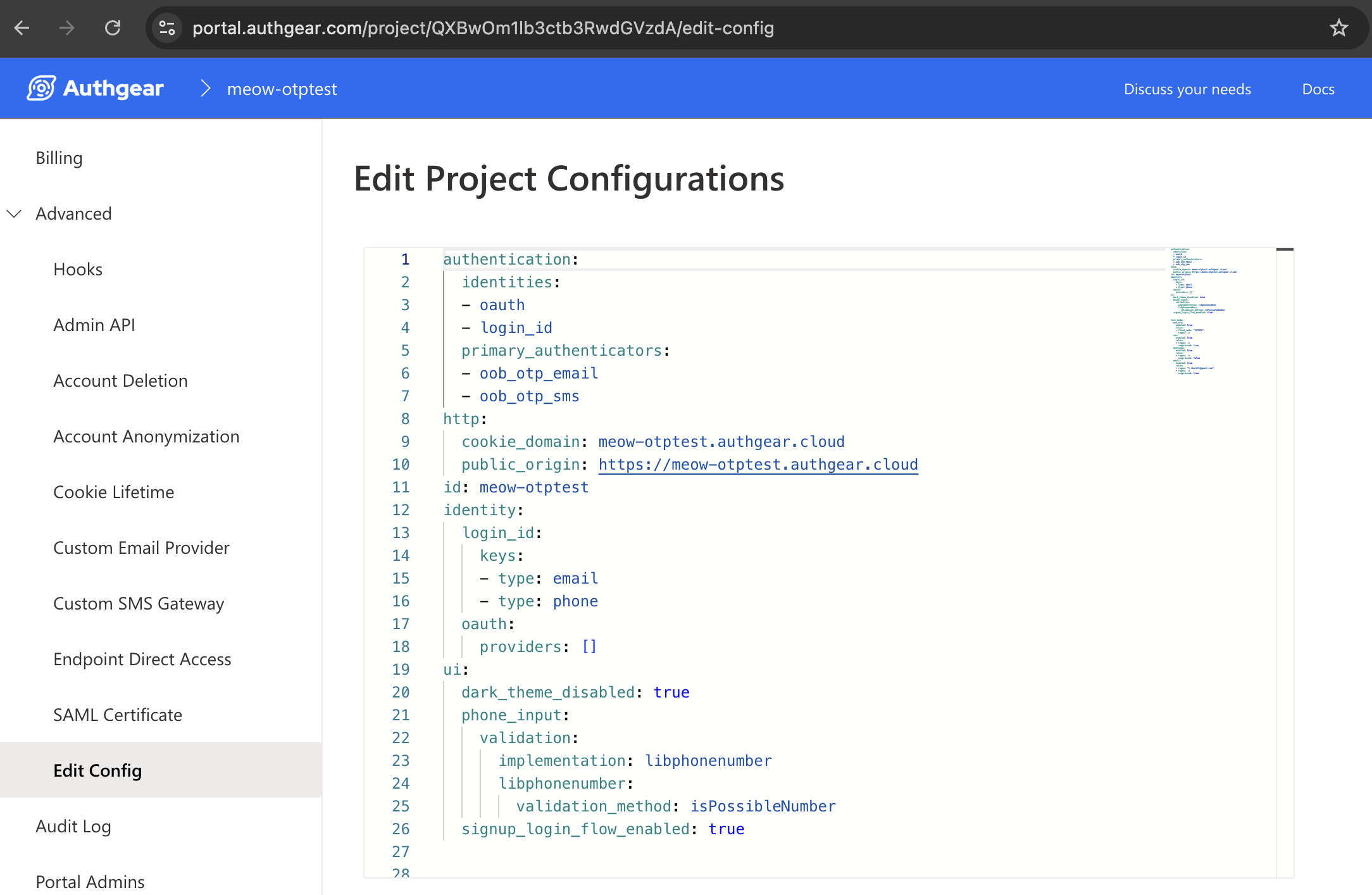
In your portal, navigate to Advanced > Edit Config
Then add the following to the yaml:
```yaml
test_mode:
oob_otp: # rules defined below apply to all OOB channels (email, sms, whatsapp)
enabled: true
rules:
- regex: .*
fixed_code: "000000"
sms: # channel specific rules defined here
enabled: true
rules:
- regex: .*
suppressed: true
```
How this works
* `regex`: Defines target emails/phone numbers the rule applies to using a regular expression
* `fixed_code`: A 6-digit code accepted as the OTP for targets
* `suppressed`: `false` by default. If `true`, messages will not be sent to the target
* `enabled`
* Set to `true` to enable test mode
* `false` by default. This means the OTP flow will work as expected, and fixed codes will not be accepted for the channel.
## Examples
### Case 1: Development
In development, you may want to use a fixed code for testing.
```yaml
test_mode:
oob_otp:
enabled: true
rules:
- regex: .*
fixed_code: "000000"
sms:
enabled: true
rules:
- regex: ^\+85291231234$ # SMS not suppressed for +85291231234
- regex: .*
suppressed: true
whatsapp:
enabled: true
rules:
- regex: .*
suppressed: true
email:
enabled: true
rules:
- regex: .*
suppressed: true
```
In this case,
* The rule in `oob_otp` matches all target so a fixed OTP `000000` will be used.
* SMS is not suppressed for `+85291231234` only. They will receive `000000` via SMS so the SMS sending capability can be tested.
* No messages will be sent to WhatsApp or email channels
{% hint style="info" %}
Since `rules` are evaluated top to bottom, always order them from most to least specific.
{% endhint %}
If the rules in `sms` were reversed in the example above, the `.*` regex would match all accounts first, making more specific rules unreachable.
### Case 2: App review
During app review, you can enable "test mode" for a specific phone number or email address that allows the account to authenticate with a fixed OTP. So this account can be shared with the app reviewer to complete the passwordless login flow
```yaml
test_mode:
oob_otp:
enabled: true
rules:
- regex: ^\+85291231234$
fixed_code: "000000"
sms:
enabled: true
rules:
- regex: ^\+85291231234$
suppressed: true
whatsapp:
enabled: true
rules:
- regex: ^\+85291231234$
suppressed: true
```
In this example,
* Only `+85291231234` can be passed with the fixed code `000000` and other accounts should use real OTP.
* SMS and WhatsApp are suppressed for `+85291231234`
---
# Agent Instructions
This documentation is published with GitBook. GitBook is the documentation platform designed so that both humans and AI agents can read, navigate, and reason over technical content effectively. Learn more at gitbook.com.
## Querying This Documentation
If you need additional information that is not directly available in this page, you can query the documentation by asking a question.
Perform an HTTP GET request on the following URL with the `ask` and `goal` query parameters:
```
GET https://docs.authgear.com/faq-for-authentication/otp-test-mode.md?ask=&goal=
```
`ask` is the immediate question: it should be specific, self-contained, and written in natural language.
`goal` is what the user is ultimately trying to achieve, the reason they need the answer. Sharing it helps GitBook give you a better, more relevant answer. A goal is most helpful when it describes the outcome the user wants rather than restating the question. For example, with `ask=how do I create an API token`, a goal like `automate deployments from our CI pipeline` lets GitBook tailor the answer to that use case.
The response will contain a direct answer to the question and relevant excerpts and sources from the documentation.
Use this mechanism when the answer is not explicitly present in the current page, you need clarification or additional context, or you want to retrieve related documentation sections.