> For the complete documentation index, see [llms.txt](https://docs.authgear.com/llms.txt). Markdown versions of documentation pages are available by appending `.md` to page URLs; this page is available as [Markdown](https://docs.authgear.com/~/changes/anTCj6yoZ06s3pLJk5v8/how-to-guide/single-sign-on/sso-with-mobile-app-web-spa.md).
# SSO with Mobile App / Web SPA
If you are building token-based websites or mobile apps, you can enable the SSO feature via the SDK.
When SSO-enabled is ON, the end-user will need to enter their authentication credentials when they login to the first app. Later on, when they login to the second app, they will see a **continue screen** so that they can log in with just a click, without authenticating themselves again.
{% hint style="info" %}
It is important that when the SSO feature is ON, don't set the `prompt` parameter when authenticating (e.g. `prompt=login`), it will force to show the login screen.
{% endhint %}
When the end-user logout the SSO-enabled app, all the apps will be logged out at the same time.
You can turn on this feature when you configure the SDK by setting the **is sso enabled** option to `true`.
{% tabs %}
{% tab title="Web" %}
```typescript
authgear.configure({
clientID: CLIENT_ID,
endpoint: ENDPOINT,
sessionType: "refresh_token",
isSSOEnabled: true,
});
```
{% endtab %}
{% tab title="React Native" %}
```typescript
authgear.configure({
clientID: CLIENT_ID,
endpoint: ENDPOINT,
isSSOEnabled: true,
});
```
{% endtab %}
{% tab title="Flutter" %}
```dart
final authgear = Authgear(
clientID: CLIENT_ID,
endpoint: ENDPOINT,
isSsoEnabled: true,
);
```
{% endtab %}
{% tab title="Xamarin" %}
```csharp
var authgearOptions = new AuthgearOptions
{
ClientId = CLIENT_ID,
AuthgearEndpoint = ENDPOINT,
IsSsoEnabled = true,
};
// Android
#if __ANDROID__
var authgear = new AuthgearSdk(GetActivity().ApplicationContext, authgearOptions);
#else
#if __IOS__
var authgear = new AuthgearSdk(UIKit.UIApplication.SharedApplication, authgearOptions);
#endif
#endif
```
{% endtab %}
{% tab title="iOS" %}
```swift
Authgear(
clientId: CLIENT_ID,
endpoint: ENDPOINT,
isSSOEnabled: true,
)
```
{% endtab %}
{% tab title="Android" %}
```java
new Authgear(
getApplication(),
CLIENT_ID,
ENDPOINT,
new PersistentTokenStorage(getApplication()),
true // isSsoEnabled = true
);
```
{% endtab %}
{% endtabs %}
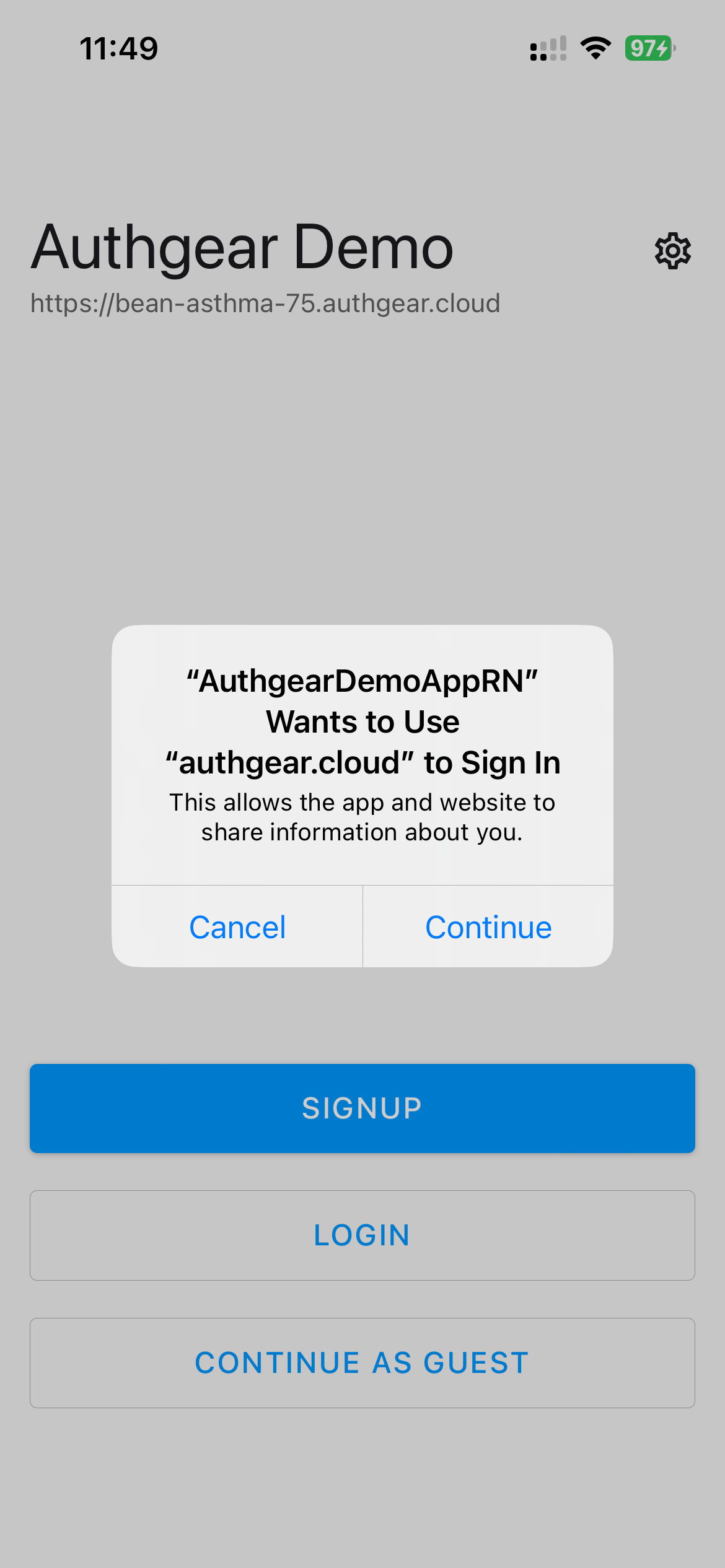
These type of SSO requires sharing the cookies between mobile apps and the system browsers on mobile, hence underlying it use `ASWebAuthenticationSession` on iOS and `Custom Tab` on Android, which will show a popup box like this:
If you want to avoid the said popup box, you will need to use `WKWebView` on iOS and `WebKitWebView` on Android for `UIImplementation` instead; And use [App2App Login](/~/changes/anTCj6yoZ06s3pLJk5v8/how-to-guide/single-sign-on/app2app-authorization.md) for sharing login session between mobile apps, and [Pre-authenticated URLs](/~/changes/anTCj6yoZ06s3pLJk5v8/how-to-guide/single-sign-on/pre-authenticated-urls.md) between mobile and web instead.
---
# Agent Instructions
This documentation is published with GitBook. GitBook is the documentation platform designed so that both humans and AI agents can read, navigate, and reason over technical content effectively. Learn more at gitbook.com.
## Querying This Documentation
If you need additional information that is not directly available in this page, you can query the documentation dynamically by asking a question.
Perform an HTTP GET request on the current page URL with the `ask` query parameter, and the optional `goal` query parameter:
```
GET https://docs.authgear.com/~/changes/anTCj6yoZ06s3pLJk5v8/how-to-guide/single-sign-on/sso-with-mobile-app-web-spa.md?ask=&goal=
```
`ask` is the immediate question: it should be specific, self-contained, and written in natural language.
`goal` is optional and describes the broader end goal you are ultimately trying to accomplish on behalf of the user. GitBook uses it to tailor the answer towards what is most useful for that goal.
The response will contain a direct answer to the question and relevant excerpts and sources from the documentation.
Use this mechanism when the answer is not explicitly present in the current page, you need clarification or additional context, or you want to retrieve related documentation sections.