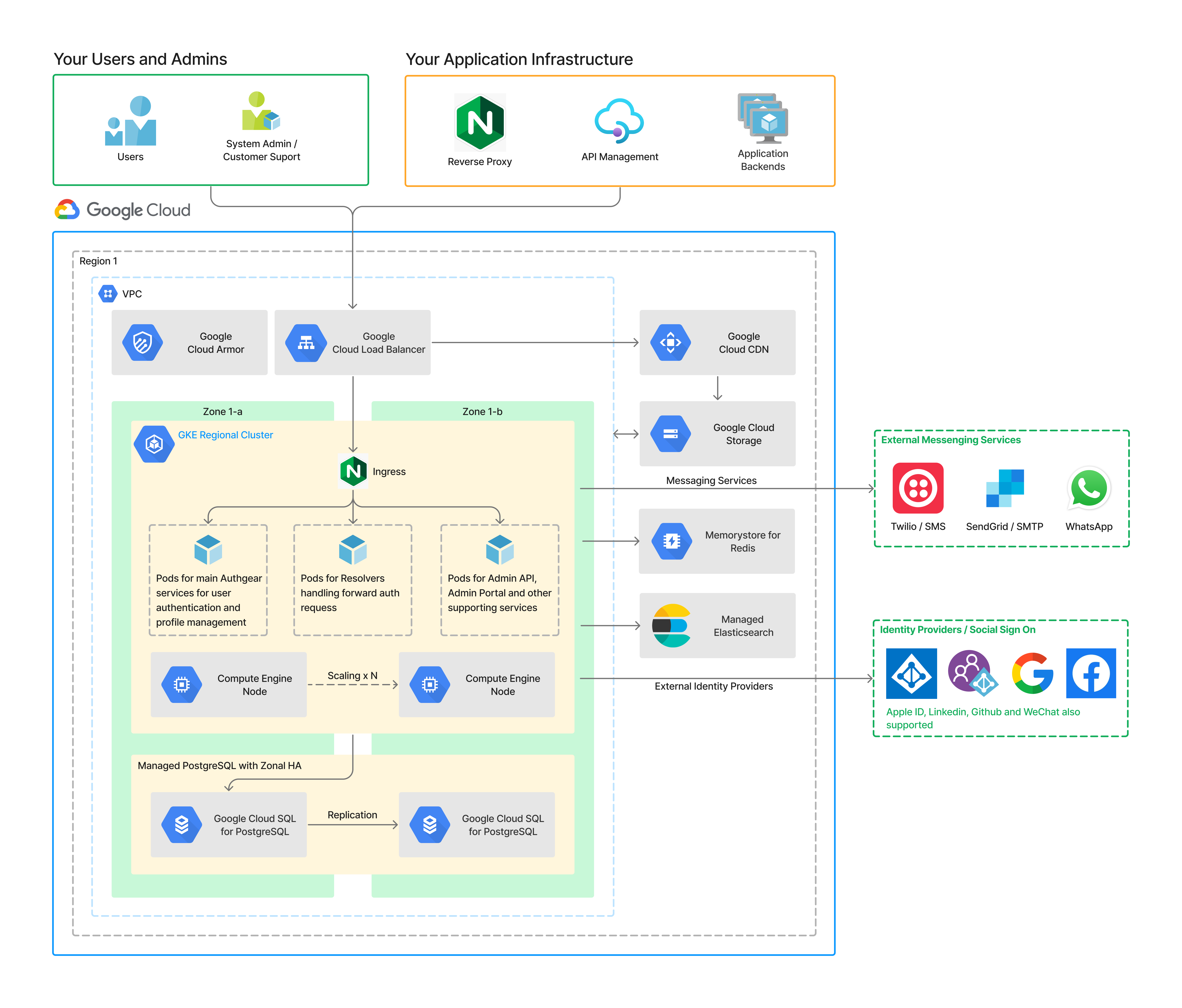
# Google Cloud Reference Architecture

<figure><img src="/files/MnGXCEpSQ6RFaXWDfa9Z" alt=""><figcaption></figcaption></figure>

([Link](https://oursky.notion.site/Authgear-Reference-Architecture-Public-Page-099f15d621784f9299c86a6dcf55bade) to download original FigJam file)

### Cloud Resources Requirements

<table data-full-width="false"><thead><tr><th width="188">Products</th><th width="309">Purposes</th><th>Suggested Specification</th></tr></thead><tbody><tr><td>Google Kubernetes Engine</td><td>Pods to run the applications, cache for user sessions</td><td>e2-standard-2 (2 vCPUs, 8GB RAM)<br>x 3 minimum for k8s</td></tr><tr><td>Google Cloud SQL for PostgreSQL</td><td>Store system settings, user profiles, audit logs</td><td>db-standard-2 (2 vCPUs, 7.5GB RAM)<br>x 2 for high availability</td></tr><tr><td>Memorystore for Redis</td><td>Store user sessions and usage analytics</td><td>Require approximately 30kB per user. Please refer to <a data-mention href="/pages/c4clmqzHxcQ02HVuiR96">/pages/c4clmqzHxcQ02HVuiR96</a></td></tr><tr><td>(Optional Components)</td><td><p>Google Cloud Storage:</p><ul><li>Storage of the user profile images</li></ul><p>Managed Elasticsearch:</p><ul><li>To support search in Authgear admin portal</li></ul><p>Networking:</p><ul><li>Google Cloud Armor (WAF)</li><li>Google Cloud Load Balancer</li><li>Google Cloud CDN</li></ul><p>CI/CD</p><ul><li>Container registry</li><li>Secret management</li></ul><p>Logging and Monitoring tools</p></td><td>N/A</td></tr></tbody></table>


---

# Agent Instructions: Querying This Documentation

If you need additional information that is not directly available in this page, you can query the documentation dynamically by asking a question.

Perform an HTTP GET request on the current page URL with the `ask` query parameter:

```
GET https://docs.authgear.com/deployment/architecture-guides/google-cloud-reference-architecture.md?ask=<question>
```

The question should be specific, self-contained, and written in natural language.
The response will contain a direct answer to the question and relevant excerpts and sources from the documentation.

Use this mechanism when the answer is not explicitly present in the current page, you need clarification or additional context, or you want to retrieve related documentation sections.
